Handicap Parking Permit Reciprocity
 by Nida Hammad
 Last updated:


Handicap parking permit reciprocity is one of the most important protections available to Americans with disabilities who travel beyond their home state. It means that a disability parking placard issued in one state is legally recognized and accepted in every other state across the country. Whether you are taking a weekend road trip, flying to a different city, or relocating temporarily, understanding how handicap parking permit reciprocity works can save you from confusion, wrongful tickets, and unnecessary stress. This guide covers the federal law behind reciprocity, what it does and does not protect, how privileges vary by state, and how to make sure your permit is ready before you travel.
What Is Handicap Parking Permit Reciprocity?
Handicap parking permit reciprocity refers to the legal obligation of every U.S. state to honor a valid disability parking permit that was issued by a different state. This is not a courtesy or an informal agreement between individual states. It is a binding federal requirement that applies uniformly across the entire country, including Washington D.C. and U.S. territories.
In practical terms, it means that if you have a valid blue permanent placard or a red temporary placard issued by your home state, you can park in any accessible parking space in any other state, just as you would at home. The International Symbol of Access printed on your placard is the universal identifier that enforcement officers use to confirm the permit belongs to the class of documents covered under reciprocity.
According to HandicapMD’s state-by-state guide, all 50 states, Washington D.C., and U.S. territories legally recognize disability placards and license plates issued by other jurisdictions, though the scope of parking privileges attached to the placard can vary significantly from one location to another.
The Federal Law Behind Handicap Parking Permit Reciprocity
The legal foundation for handicap parking permit reciprocity in the United States is 23 CFR Part 1235, titled the Uniform System for Parking for Persons with Disabilities. This regulation, administered by the Federal Highway Administration (FHWA), was published in 1991 and derives its authority from Public Law 100-641, signed into law in 1988. Section 1235.8 of this regulation is the specific provision that establishes reciprocity.
The regulation instructs states to issue special license plates and removable windshield placards upon physician certification, sets display standards for how placards must be shown in a vehicle, and mandates that all qualifying permits from other states be recognized. The Legal Information Institute at Cornell Law maintains a publicly accessible version of this regulation along with all subsections.
What the Reciprocity Rule Covers
The reciprocity requirement under 23 CFR §1235.8 applies to three categories of disability parking credentials:
-
Permanent removable windshield placards (typically blue with the International Symbol of Access on a blue shield)
-
Temporary removable windshield placards (the same symbol, usually on a red shield, valid for up to six months)
-
Disability license plates permanently affixed to a vehicle
This means if your vehicle has disability license plates from your home state, you do not need to carry a separate hanging placard when traveling. Both credentials are protected under the same reciprocity rule.
What Your Permit Allows in Other States
Handicap parking permit reciprocity guarantees one core right: access to any designated accessible parking space in every state. This is a universal protection. No state can legally refuse to recognize your out-of-state placard when you park in an accessible space. The ADA clarifies that when state and local governments, businesses, and non-profit organizations provide parking lots or garages, accessible parking spaces complying with the Americans with Disabilities Act must be provided, and these spaces must be available to all valid permit holders.
Privileges That Can Vary State to State
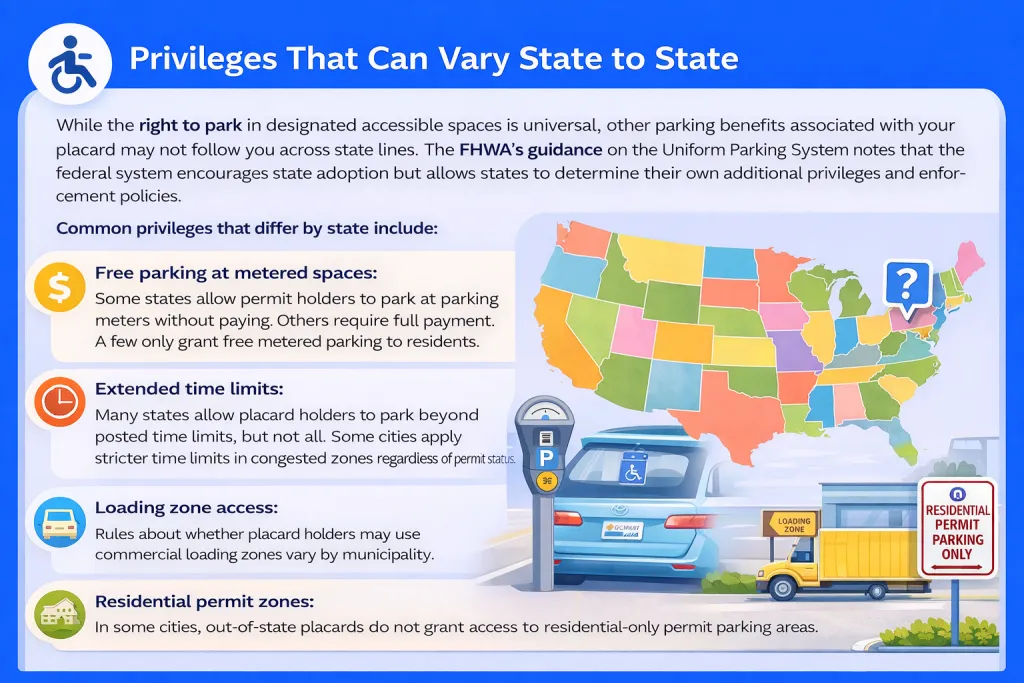
While the right to park in designated accessible spaces is universal, other parking benefits associated with your placard may not follow you across state lines. The FHWA’s guidance on the Uniform Parking System notes that the federal system encourages state adoption but allows states to determine their own additional privileges and enforcement policies.
Common privileges that differ by state include:
-
Free parking at metered spaces
-
Extended time limits
-
Loading zone access
-
Residential permit zones
Types of Permits Covered Under Handicap Parking Permit Reciprocity
Not all disability parking credentials look the same across every state, but federal standards provide enough uniformity that they are recognized nationwide. There are several types of permits that fall under handicap parking permit reciprocity:
Permanent placards are issued to individuals with chronic or long-term conditions that substantially limit mobility. These are typically blue, valid for two to six years depending on the issuing state, and may or may not require medical recertification at renewal.
Temporary placards are issued for disabilities expected to last no more than six months, such as a post-surgical recovery or a short-term injury. These are typically red and require a physician’s certification specifying the period of disability.
Disability license plates are permanently attached to the vehicle and carry the International Symbol of Access. These are particularly useful for frequent travelers because they eliminate the need to transfer a hanging placard between vehicles.
The U.S. Access Board confirms that all accessible spaces must be identified with the International Symbol of Accessibility and must meet specific design standards, ensuring that permit holders can reliably identify and use qualifying spaces in any state.
Need a disability parking permit before your next trip? ParkingMD connects you with licensed physicians online to complete your DMV evaluation from home, with same-day delivery of your physician-signed forms. No office visits, no waiting. See if you qualify at ParkingMD today.
How to Stay Compliant When Traveling with Your Placard
Even with handicap parking permit reciprocity protecting you across every state, there are practical steps you should take to avoid complications when traveling. Enforcement officers in some states may be unfamiliar with out-of-state placards, and having the right documentation on hand can resolve any confusion quickly.
Display Rules and Documentation to Carry
- How to Display and Manage Your Handicap Placard Correctly
Getting your placard approved is one thing. Using and managing it correctly is another. These rules aren’t complicated, but they’re specific, and getting them wrong can result in citations, fines, or losing the placard entirely. Here’s exactly what you need to know.
- Hang your placard from the rearview mirror whenever parked in an accessible space, and remove it before driving.
This is the most fundamental display rule, and it applies in every state. When your vehicle is parked in a designated accessible space, the placard must hang from the rearview mirror with the front facing outward. This means the expiration date, permit number, and identifying information are clearly visible through the windshield to any parking enforcement officer walking past.
As the Los Angeles Department of Transportation states directly: if the information on the placard is not visible to a passing enforcement official, it can legally be assumed the placard is invalid. Visibility isn’t optional. It’s the legal standard.
The flip side of that rule is equally important: remove the placard before you drive away. Driving with a placard hanging from the rearview mirror is not just a bad habit. It’s dangerous and illegal. The placard obstructs your sightline, and multiple state DMVs, including Delaware’s Division of Motor Vehicles, explicitly require that the placard be removed from the mirror when the vehicle is in motion. Pull into the space, hang the placard. Pull out of the space, take it down. That’s the sequence, every time.
If your vehicle has no rearview mirror, or if the mirror placement genuinely isn’t possible, most states allow the placard to be placed face-up on the dashboard to the left of the steering wheel, ensuring it remains readable from outside. But rearview mirror display is the standard and should be your default.
- Carry your placard registration card at all times.
When your state issues a placard, it typically also issues an accompanying identification card or registration document. This card lists your permit number, expiration date, and your identifying information as the permit holder.
Virginia’s DMV is explicit about this requirement. According to the Virginia DMV’s disability program guidelines, the placard holder is required to carry the Disabled Parking Placard Identification Card issued with the placard and to present it to a law enforcement officer upon request. Other states have similar requirements, even if they don’t all spell it out as clearly.
Keep this card in your wallet or in the vehicle’s glove box. It serves as the link between you and the placard, proof that the permit belongs to you, not just that someone left a placard in the car.
- If your state issued a paper ID card along with your placard, keep it in the glove box alongside your vehicle registration.
Many states issue a secondary document alongside the physical placard. Sometimes it’s called a placard ID card, a registration card, or a disability certification card. This document is separate from your placard and serves as backup verification of your permit status.
Keeping it in the glove box alongside your vehicle registration is practical for a simple reason: if you’re ever questioned by an officer about the placard’s validity or whether you’re the legitimate holder, you can produce both documents immediately without fumbling. It also protects you if the placard itself is ever damaged or becomes difficult to read, since stained or torn placards that compromise legibility should be replaced promptly. The LADOT parking authority notes this standard directly.
For caregivers transporting a dementia patient: keep both the placard and the accompanying ID card accessible in whichever vehicle is used most frequently for outings. If multiple family members transport the patient in different vehicles, the placard and card should travel with the patient, not stay permanently in one car.
- Note the expiration date on your placard before traveling. An expired placard is not protected by reciprocity.
All 50 states honor valid disability placards issued by other states. But that reciprocity applies only to current, unexpired permits. An expired placard provides no legal protection anywhere in the country, regardless of which state issued it or how recently it expired.
North Carolina’s DMV notes that violations of accessible parking requirements carry penalties of $100 to $250, with the possibility of towing. Those penalties apply whether your placard is borrowed, misused, or simply expired. The state you’re visiting won’t make an exception because the permit was valid last month.
Check the expiration date printed on your placard before any out-of-state trip. Renewal should be handled before travel, not after a citation. Most states send renewal reminders, but don’t rely on that alone. Make it a habit to verify the date at the start of each year and before any extended travel.
- If your vehicle has disability license plates, you generally do not need an additional placard, but carry your plate registration documentation.
Disability license plates and placards serve the same purpose and grant the same parking privileges. The key difference is flexibility. License plates are permanently affixed to a specific vehicle and travel with that vehicle. A placard, as the California DMV explains, can be moved from one vehicle to another. This makes it a better option for people who ride in multiple vehicles or are transported by caregivers in different cars.
If your vehicle has disability plates, you don’t need to hang an additional placard in the same vehicle. The plates serve as your permit. But carry your plate registration documentation with you, just as you would a placard ID card. This documentation confirms the plates are issued to you as the qualifying individual, not simply that the vehicle happens to have those plates.
One important note for families: disability plates stay with the vehicle. If the permit holder is a passenger in a different vehicle that doesn’t have disability plates, a separate placard is needed for that trip. This is one reason many families apply for both a placard and plates. The plates cover the primary vehicle, and the placard covers any other vehicle the permit holder rides in.
What Happens If You Get Ticketed Out of State?
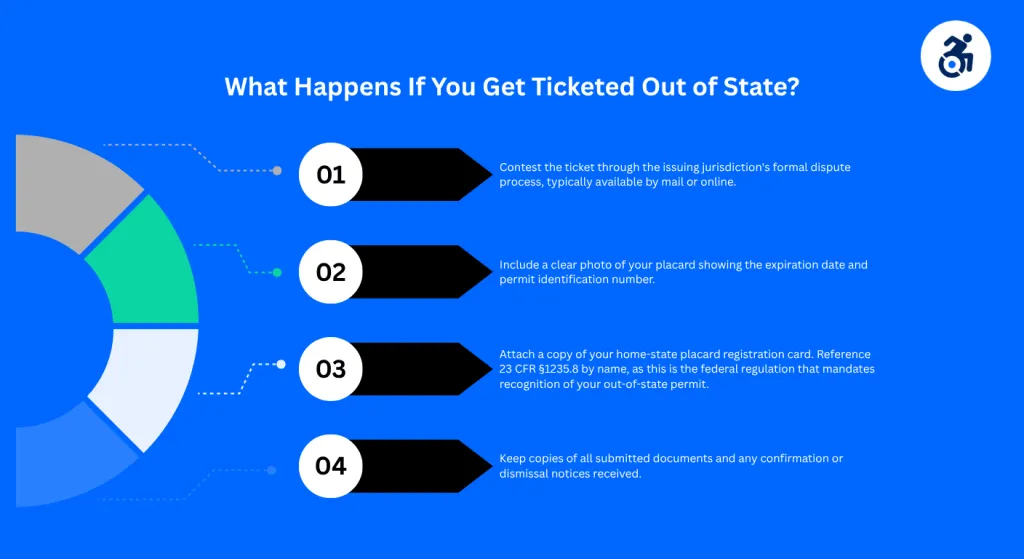
Wrongful tickets for displaying a valid out-of-state placard are relatively rare, but they do occur. If you receive a citation while properly displaying a valid permit from your home state, you have a clear legal basis to contest it.
To dispute the ticket effectively:
-
Contest the ticket through the issuing jurisdiction’s formal dispute process, typically available by mail or online.
-
Include a clear photo of your placard showing the expiration date and permit identification number.
-
Attach a copy of your home-state placard registration card.
-
Reference 23 CFR §1235.8 by name, as this is the federal regulation that mandates recognition of your out-of-state permit.
-
Keep copies of all submitted documents and any confirmation or dismissal notices received.
Most jurisdictions dismiss these citations once they verify that the placard is valid and properly displayed. The Congressional Research Service report on federal disability parking law confirms that the federal reciprocity mandate is legally binding and that state parking systems must comply with it.
Getting Your Permit Ready Before You Travel
If you are planning a trip and your current placard is expired, close to expiring, or if you have never applied for one, taking action before your trip is far easier than trying to secure access in an unfamiliar state. The U.S. Department of Transportation’s disability policy framework emphasizes that safe and accessible travel remains a core national priority, and the physician certification process is the key first step in obtaining a placard.
Under 23 CFR §1235.4, every state requires a licensed physician’s certification confirming that the applicant meets the eligibility definition of a person with a disability that limits or impairs the ability to walk. This is the document your DMV needs before it can issue any placard. Knowing what medical records to bring to that evaluation makes the process faster and smoother. ParkingMD’s complete medical records guide for disability parking permits explains exactly which records, from recent visit notes to imaging reports and specialist letters, are most useful for your physician evaluation.
Once you have your physician-signed certification, you submit it to your state’s DMV or motor vehicle agency. The placard issued by your home state is then valid in all 50 states under the handicap parking permit reciprocity rule, from the date of issue through its expiration.
Renewing or applying for the first time? ParkingMD has helped over 33,000 patients get their physician-signed DMV forms without ever leaving home. The process takes just minutes, forms are delivered the same day, and approval is guaranteed or your money back. Start your evaluation at ParkingMD now.
Handicap Parking Permit Reciprocity and International Travel
The reciprocity protections under 23 CFR §1235.8 apply only within U.S. jurisdiction. However, travelers heading to Canada have additional protections available. Canada formally recognizes U.S. disability parking permits under a mutual recognition agreement, provided the placard displays the International Symbol of Access, which all standard U.S. placards already carry.
For travel to other countries, the rules vary widely. Many European nations use a standardized Blue Badge system, and some countries will grant temporary access to holders of foreign disability permits if the permit bears the internationally recognized wheelchair symbol. Travelers are advised to contact the destination country’s transportation or accessibility authority well in advance of departure.
Misuse Penalties and Why They Matter for Permit Holders
Understanding handicap parking permit reciprocity also means understanding the rules that apply to your own use of the permit. Reciprocity protects valid permits used by their rightful holders. It does not protect misuse, and enforcement has become significantly stricter in recent years.
Key Rules That Apply in Every State
No matter where you live or which state issued your placard, a few rules are universal. These aren’t technicalities buried in fine print — they’re the rules that get people into real trouble when they’re ignored. Understanding them upfront protects both you and the person the placard was issued for.
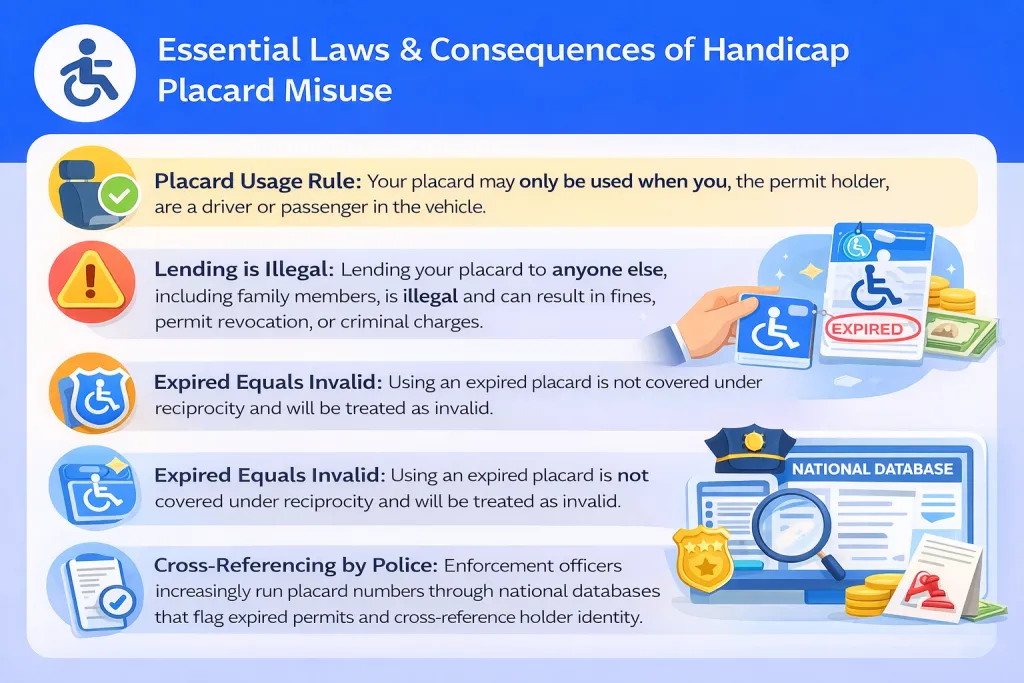
Your placard may only be used when you, the permit holder, are a driver or passenger in the vehicle.
This is the most important rule and the one most commonly misunderstood. The placard belongs to the person with the qualifying disability, not to a vehicle and not to a family. It is valid only when the permit holder is physically present — either driving or riding as a passenger. The moment they step out of the car and someone else drives off with the placard still displayed, that’s a violation. It doesn’t matter that the driver is a spouse, an adult child, or a full-time caregiver. Presence is the requirement, and there are no exceptions.
For caregivers of dementia patients specifically, this means the placard stays home on days when the patient stays home. It goes with the patient, not with the car.
Lending your placard to anyone else — including family members — is illegal and can result in fines, permit revocation, or criminal charges.
This surprises a lot of people. It feels harmless to let a family member borrow a placard for a quick errand, especially when they’re running that errand on behalf of the permit holder. But the law doesn’t make that distinction. The placard is a government-issued accessibility document, not a household convenience item.
Penalties vary by state but they are not trivial. Fines commonly range from $250 to $1,000 for a first offense. In some states, misuse is classified as a misdemeanor, which means a criminal record. And beyond the financial penalty, the placard itself can be permanently revoked — meaning the person who genuinely needs it loses access entirely because of someone else’s misuse. That’s a consequence worth taking seriously.
Using an expired placard is not covered under reciprocity and will be treated as invalid.
All 50 states honor valid disability placards issued by other states. But that reciprocity applies only to current, unexpired permits. An expired placard offers no protection, no matter which state issued it or how recently it expired. If you’re traveling and your placard expired last month, you are not covered. Renewal should be handled before travel, not after a citation.
Enforcement officers increasingly run placard numbers through national databases that flag expired permits and cross-reference holder identity.
Enforcement has become significantly more sophisticated in recent years. Officers no longer rely solely on visual inspection of the placard date. Many jurisdictions now have access to real-time database checks that can verify whether a placard is current, whether the listed holder matches the vehicle’s occupant, and whether the permit has been flagged for previous misuse. Assuming no one is checking is no longer a safe assumption. The technology has caught up with the problem, and enforcement agencies in high-traffic areas particularly have made placard misuse a consistent enforcement priority.
The bottom line is straightforward: use the placard only as intended, keep it current, and never let it leave the car with someone who isn’t the permit holder. These rules exist to preserve accessible parking for the people who genuinely depend on it.
Violations may result in fines exceeding one thousand dollars, license suspensions, and in some states, possible criminal charges for fraud. Respecting the rules protects not only your own permit but also the accessible spaces that all permit holders depend on.
Frequently Asked Questions
Is my handicap parking permit valid in all 50 states?
Yes. Under 23 CFR §1235.8, all 50 states, Washington D.C., and U.S. territories are required to recognize disability placards and disability license plates issued by any other state. This is a federal mandate, not a state-by-state agreement. Both permanent and temporary placards are covered under this rule.
Does handicap parking permit reciprocity include free meter parking in other states?
Not automatically. Handicap parking permit reciprocity guarantees access to designated accessible parking spaces in every state, but additional privileges like free metered parking are set independently by each state or municipality. Some states extend meter exemptions to out-of-state permit holders, while others do not. Always check the local rules before assuming a meter exemption applies.
What should I do if I receive a parking ticket while using my out-of-state placard?
Contest the ticket through the issuing jurisdiction's dispute process. Provide a photo of your placard showing the permit number and expiration date, a copy of your home-state registration card, and a citation of 23 CFR §1235.8. Most jurisdictions will dismiss the citation once they confirm your placard is valid and properly displayed.
Do I need to get a new placard when I move to a different state?
Yes. Once you establish residency in a new state, you are generally required to apply for a placard from your new home state's DMV. While your existing placard may remain valid for use during a transition period, you should not rely on an out-of-state placard as a permanent solution once you have changed your permanent address. Contact your new state's DMV for specific timelines and requirements.
Is a temporary placard covered by reciprocity when traveling?
Yes. Temporary placards are explicitly included in the reciprocity mandate under 23 CFR §1235.8. A valid, non-expired red temporary placard from your home state must be recognized in every other state. As with permanent placards, verify that the placard has not expired before traveling, since an expired temporary placard provides no reciprocity protection.
Can I complete my physician evaluation online before applying for a placard?
Yes. Services like ParkingMD connect patients with licensed physicians via secure online appointments, allowing you to complete your DMV disability parking permit evaluation without leaving home. Once approved, you receive physician-signed, DMV-ready forms the same day, which you then submit to your state's motor vehicle agency to receive your placard.

Meet the author
Nida Hammad
I am a professional writer with over five years of experience creating clear, engaging, and well-researched content. I specialize in mobility and accessibility topics, helping readers understand handicap parking permits and related regulations in simple, easy-to-follow language. Currently, I write for Parking MD, where I focus on producing accurate, trustworthy guides to help individuals navigate the handicap parking permit application process with confidence.
Get an Accessible Parking Permit Evaluation in Minutes.