
How Do You Apply for a Handicapped Parking Permit? Apply For Someone
 by Nida Hammad
 Last updated:


Your parent can barely get to the car, let alone stand in a DMV line. Your spouse just had surgery and needs a short-term placard but cannot drive anywhere. You are the one doing the research, making the calls, and trying to figure out whether you can just handle this for them.
The good news is that you most likely can. This guide answers how do you apply for a handicapped parking permit when you are doing it on someone else’s behalf, from start to finish. It covers what you need, whether the permit holder has to be present, how the physician certification works, and how ParkingMD makes the hardest part of the process easy to handle from home.
Whether you are a spouse, adult child, professional caregiver, or legal guardian, the steps to apply for a handicap parking permit for someone else are clear and manageable. Let’s walk through them.
Can Someone Else Apply for a Handicap Parking Permit?
Yes, in most states a caregiver, family member, or legal contact person can apply for a handicap parking permit on behalf of the person with the qualifying condition. According to the Oregon DMV’s disability parking, anyone can submit an application on behalf of anyone else as long as the applicant meets the requirements and all application requirements are met.
The permit is always issued in the name of the person with the disability. Not yours. This is an important distinction. The permit holder is the person with the qualifying medical condition. You are simply the person handling the paperwork on their behalf.
Most states allow a third party to fill out the application, arrange the physician certification, submit the paperwork, and receive the permit on the permit holder’s behalf. But a few states have extra requirements for caregiver applicants.
Key Rule: The Permit Is Always in the Patient’s Name
A handicap parking permit is issued to the person with the qualifying medical condition, regardless of who completes the application. The caregiver’s name does not appear on the permit. The permit belongs to the patient and can only be used when that patient is in the vehicle.This protects the permit holder’s rights and ensures the placard cannot be misused when they are not present.
The Washington Department of Licensing is one example of a state that requires an extra step for caregiver applicants. Caregivers, parents, and guardians applying for a dependent must complete a Fact Certificate form stating their connection to the permit holder. Most other states do not require this extra form, but it is worth checking your state’s specific rules before you start.
A small number of states require the permit holder’s signature on the application or require them to appear in person at the DMV for first-time applications. If you are unsure about your state’s rules, call the state DMV directly or use ParkingMD’s state-by-state resource to look up the exact requirements.
What You Need Before You Start the Application
Before you begin the application, gather everything in one place. Having these items ready makes the process much smoother and avoids delays.
Documents and Information to Gather Before Starting
The Permit Holder’s Personal Information
-
Full legal name (exactly as it appears on their ID)
-
Date of birth
-
Home address
-
Driver’s license or state-issued ID number (required in most states)
-
Social Security number (required by some states)
Medical Information
-
The permit holder’s qualifying condition and how it limits their mobility
-
Names and contact information of treating physicians
-
Any relevant medical records that document the condition (useful for ParkingMD’s physician review process)
Application Form
-
Your state’s specific disability parking application form, available on the state DMV website
-
ParkingMD can provide the correct state form and guide you through completing it
Physician Certification
-
A licensed physician must certify the qualifying condition on the medical section of the form
-
This is the step most caregivers find hardest to arrange without the permit holder visiting a doctor’s office
-
ParkingMD handles this step online with same-day sending of the signed DMV form
Caregiver Documentation (if required by your state)
-
Some states require documentation of your connection to the permit holder
-
Washington state requires a Fact Certificate form
-
Check your state’s DMV website for specific third-party applicant requirements
How Do You Apply for a Handicapped Parking Permit: Step by Step
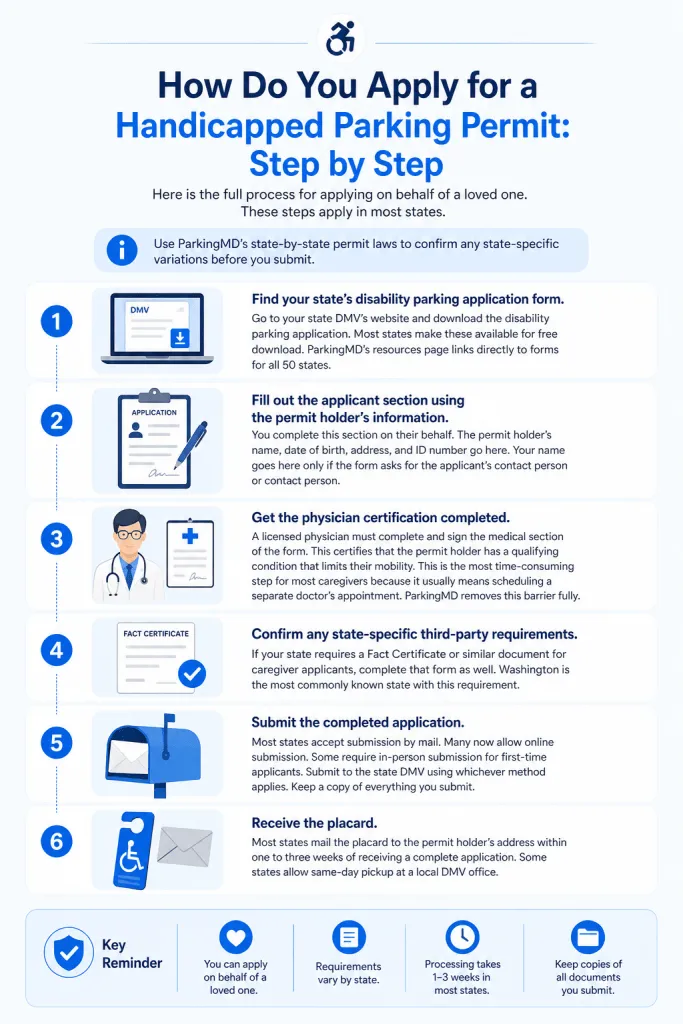
Here is the full process for applying on behalf of a loved one. These steps apply in most states. Use ParkingMD’s state-by-state permit laws to confirm any state-specific variations before you submit.
-
Find your state’s disability parking application form. Go to your state DMV’s website and download the disability parking application. Most states make these available for free download. ParkingMD’s resources page links directly to forms for all 50 states.
-
Fill out the applicant section using the permit holder’s information. You complete this section on their behalf. The permit holder’s name, date of birth, address, and ID number go here. Your name goes here only if the form asks for the applicant’s contact person or contact person.
-
Get the physician certification completed. A licensed physician must complete and sign the medical section of the form. This certifies that the permit holder has a qualifying condition that limits their mobility. This is the most time-consuming step for most caregivers because it usually means scheduling a separate doctor’s appointment. ParkingMD removes this barrier fully.
-
Confirm any state-specific third-party requirements. If your state requires a Fact Certificate or similar document for caregiver applicants, complete that form as well. Washington is the most commonly known state with this requirement.
-
Submit the completed application. Most states accept submission by mail. Many now allow online submission. Some require in-person submission for first-time applicants. Submit to the state DMV using whichever method applies. Keep a copy of everything you submit.
-
Receive the placard. Most states mail the placard to the permit holder’s address within one to three weeks of receiving a complete application. Some states allow same-day pickup at a local DMV office.
Pro Tip for Caregivers
Take a photo or make a copy of the fully completed application and the physician certification form before you mail or submit anything. If the DMV has a question or the application needs to be resubmitted, having copies on hand saves you a lot of time.
The Hardest Part Is Getting the Physician Certification. ParkingMD Makes It Easy.
Licensed physicians review the permit holder’s medical records and complete the required DMV certification form from home. No office visit. No scheduling delays. DMV-ready forms delivered the same day.
Start the Application for Your Loved One at ParkingMD.com
33,000+ patients helped | Approved or your money back | All 50 states | HIPAA-compliant
The Physician Certification: The Step That Holds Most Caregivers Up
Every state requires a licensed physician to certify that the permit holder has a qualifying condition before a disability parking permit is issued. This is not optional. No matter how clear the disability is, the DMV will not issue a placard without the physician-signed medical section of the application. See the ADA.gov accessible parking information for background on why medical certification is required under federal access standards.
For many caregivers, this is where the process stalls. The permit holder may not be well enough to go to a doctor’s appointment. The family physician may have a long wait for a non-urgent visit. And scheduling an appointment exactly to sign a DMV form can feel like one more logistical hurdle in an already full schedule.
What Conditions Qualify
The physician must certify that the permit holder has a condition that significantly limits their ability to walk. Common qualifying conditions include cardiac conditions, respiratory disorders, neurological impairments, orthopedic conditions, visual impairment of 20/200 or worse, or the loss or permanent impairment of a lower limb. Most states also recognize any condition that causes a person to use a wheelchair, walker, cane, or brace.
Who Can Sign the Form
Most states accept a signature from a licensed medical doctor (MD), doctor of osteopathy (DO), physician assistant (PA), or nurse practitioner (NP). Some states also accept optometrists for vision-related disabilities or podiatrists for foot-related conditions. The physician does not need to be the permit holder’s primary care doctor, but they must be licensed in the state.
How ParkingMD Handles This Step
ParkingMD connects caregivers and permit holders with licensed Florida physicians who review medical records and complete the required DMV certification form via telehealth. You upload the relevant medical documentation, the physician reviews the records, and the signed DMV-ready form is sent digitally the same day. No office visit. No scheduling. No waiting weeks for an appointment slot.
Traditional Physician Certification vs. ParkingMD
| Traditional Doctor Visit | ParkingMD Online Evaluation |
|---|---|
| Schedule appointment (often weeks out) | Start online today, same-day delivery |
| Permit holder must travel to office | Permit holder stays home |
| Full office visit for form signature only | Physician reviews records, no visit needed |
| Forms may take days to receive back | DMV-ready forms delivered same day |
| Additional office visit copay or fee | Lowest cost in the US |
| Available during office hours only | Available any time |
Can a Caregiver Use the Handicap Parking Permit?
This is one of the most common points of confusion, so let’s be direct. Applying for the permit and using the permit are two completely separate questions with different rules. Many caregivers assume that because they handled the application, they can use the placard freely. That is not how it works.
A caregiver can use the handicap parking placard when the permit holder is in the vehicle in person. The placard follows the person, not the car. If you are driving your parent to a medical appointment, you can park in a designated accessible space using their placard. That is legal and appropriate.
What is not allowed: using the placard when the permit holder is not in the vehicle. Running errands on their behalf, picking up groceries, or parking at their building while they are inside does not qualify. The permit holder must be present.
The key rule to remember: the placard is issued to a person, not a vehicle. It can be moved between cars as long as the permit holder is riding in whichever vehicle it is displayed on.
Temporary vs. Permanent Permits: Which One Does Your Loved One Need?
Before you submit the application, you need to know which type of permit to apply for. The physician who completes the certification section will indicate which type is appropriate based on the permit holder’s condition.
Temporary vs. Permanent Handicap Parking Permits
| Short-Term Permit | Permanent Permit |
|---|---|
| For conditions expected to resolve, such as surgery recovery | For long-term or permanent conditions |
| Valid for 3 to 6 months depending on state, or until physician-specified date | Renewed every 2 to 5 years depending on state |
| Requires new physician certification for each application | Many states do not require re-certification for renewal |
| Caregiver can apply on behalf of the permit holder | Caregiver can apply on behalf of the permit holder |
| Good for post-surgery, broken bones, short-term mobility issues | Good for chronic conditions, permanent disabilities |
If you are applying ahead of a scheduled surgery, start the ParkingMD process at least one week before the procedure date. This gives enough time for the physician review and form delivery before the permit holder needs the placard.
Some states issue the placard immediately on submission for certain conditions. Others take two to three weeks to process and mail. If timing is critical, ask your state DMV whether expedited processing is available.
Both temporary and permanent permits can be applied for by a caregiver in states that allow third-party applications. The physician certification process through ParkingMD works the same way for both. See the ParkingMD reviews to read how other caregivers have used the service for their family members.
Conclusion
Asking how do you apply for a handicapped parking permit on someone else’s behalf is one of the most practical questions a caregiver can ask. And the answer is reassuring: in most states, you can handle this entire process without the permit holder needing to visit a DMV office or a doctor’s office.
The steps are clear. Gather the permit holder’s information. Get the state application form. Complete the physician certification. Submit to the DMV. Receive the placard.
The hardest part for most caregivers is the physician certification. ParkingMD removes that barrier fully. You can apply for a handicap parking permit for someone else and get the physician-signed DMV forms delivered the same day, all from home.
**Handle the Entire Process From Home, For Your Loved
**One.ParkingMD connects you with licensed physicians who complete the required DMV certification for your family member’s handicap parking permit without any in-person appointments. Same-day digital delivery. Approved or your money back.
Get Started at ParkingMD.com
33,000+ patients helped | All 50 states | HIPAA-compliant | Lowest cost in the US
Frequently Asked Questions
Can someone else apply for a handicap parking permit on your behalf?
Yes, in most states a caregiver, family member, or legal contact person can apply for a handicap parking permit on behalf of the person with the qualifying condition. The permit is always issued in the permit holder's name. Some states, like Washington, require a Fact Certificate form stating the caregiver's connection to the permit holder. Check your state DMV's website or use ParkingMD's state-by-state resource for specific requirements.
How do you apply for a handicapped parking permit?
To apply for a handicapped parking permit, you need your state's disability parking application form, the permit holder's personal information, and a physician-signed certification of the qualifying condition. Fill out the application using the permit holder's information, get the physician certification completed, and submit to the state DMV by mail, online, or in person depending on your state. ParkingMD handles the physician certification step online with same-day form delivery.
Can a caregiver use a handicap parking permit?
A caregiver can use a handicap parking placard when they are transporting the permit holder and the permit holder is in the vehicle in person. The placard cannot be used when the permit holder is not present, even for errands done on their behalf. Using the placard without the permit holder in the vehicle is illegal in all 50 states.
What documents do you need to apply for a handicap placard?
You need the permit holder's full legal name, date of birth, address, and driver's license or state ID number. You also need your state's disability parking application form and a completed physician certification confirming the qualifying condition. Some states require extra caregiver records. ParkingMD can help you gather and complete all required forms.
How long does it take to get a handicap parking permit?
Processing times vary by state. Most states mail the placard within one to three weeks of receiving a complete application. The most common cause of delays is an incomplete application or missing physician certification. ParkingMD delivers the physician-signed DMV form the same day, which removes the most common bottleneck in the process.
Can you apply for a handicap placard online?
Many states now allow online applications for disability parking permits. Others require mail or in-person submission for first-time applicants. ParkingMD's online physician evaluation works for all 50 states regardless of how your state handles DMV submission. You can complete the physician certification step fully online and then submit the signed form to your state DMV using your state's preferred method.
Does a family member need to be present to apply for a handicap permit?
In most states, the permit holder does not need to be present during the application process. A family member or caregiver can fill out the form, arrange the physician certification, and submit the application fully on the permit holder's behalf. A small number of states require the permit holder's signature on the application or require in-person verification. Check your state's rules before you start using ParkingMD's state-by-state resource page.

Meet the author
Nida Hammad
I am a professional writer with over five years of experience creating clear, engaging, and well-researched content. I specialize in mobility and accessibility topics, helping readers understand handicap parking permits and related regulations in simple, easy-to-follow language. Currently, I write for Parking MD, where I focus on producing accurate, trustworthy guides to help individuals navigate the handicap parking permit application process with confidence.
Get an Accessible Parking Permit Evaluation in Minutes.